Designing
for the long run.
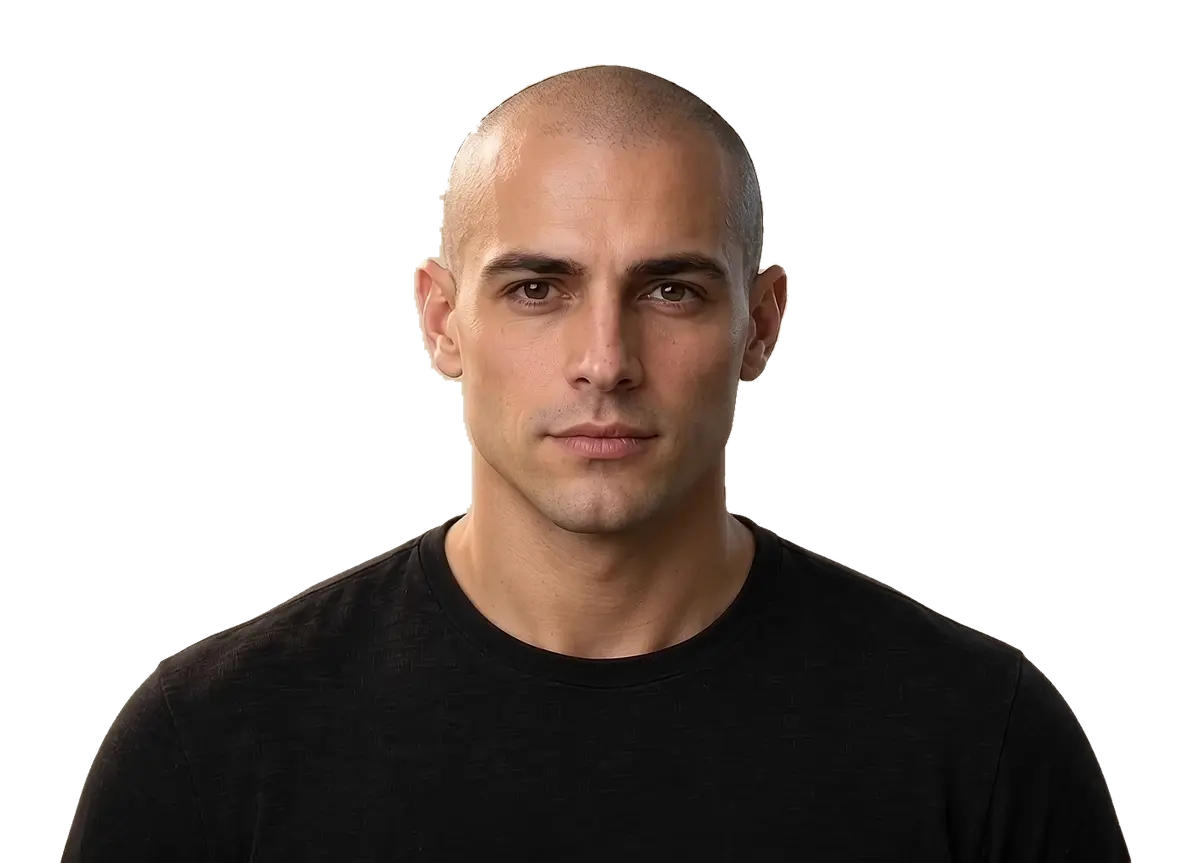
Where your hairline sits decides whether a transplant looks natural, now and when you are sixty.
A generated illustration. It is not a photograph of Dr. Atul or a patient, and not a predicted result.
Hairline design
A good hairline
looks like it was always there.
When you notice a transplant, you notice the hairline, not how thick the hair is or how many grafts went in. The hairline sits at eye level, in daylight, where people look when they talk to you.
Single hairs at the very front, fuller grafts behind them. The hair fades in, so the eye finds no line to stop at.
A hairline is
a soft edge.
In a photo a hairline looks like a border. On a real head it fades in over a few millimetres. Build it as a hard border and the hair looks put in.
At the very front of a natural hairline are single, fine hairs, spread out. Behind them the hairs come in groups of two and three and sit closer together, until a few millimetres back the hair is at full thickness.
Copying that means sorting the grafts before placing them. Single-hair grafts go at the front, and two- and three-hair grafts go behind. Putting the same graft everywhere gives a wall of hair with a clear front edge. It is thick and even, and it looks wrong.
Send a photo of your hairline on WhatsAppIrregular
on purpose.
Perfect symmetry is the other giveaway. Real hairlines wander. They differ slightly on the left and the right, rise and dip across the forehead, and have the odd hair out in front.
A well designed hairline copies that on purpose. The shape is broken up so it does not look drawn, and a few single hairs are placed ahead of the rest. That detail stops the eye from finding where the hair starts.
It takes longer than placing an even row, and it is what makes a hairline look grown rather than placed.
The corners sit back, the two sides are not quite the same, and a few loose hairs sit ahead of the rest.
The corners
frame the face.
The corners, where the hairline turns back toward the temple, are the part surgeons most often get wrong.
Those angles make a hairline look like yours instead of a template.
They have to agree with everything else: the shape of the forehead, the set of the brow, how the hair grows on either side, and how much has already gone. A shape that suits one face looks drawn on another.
This is the part of a consultation worth spending time on. Ask to see the line before anything else is agreed, and ask why it sits where it does.
The hairline
you will still want.
The commonest regret in this field is a hairline placed where it used to be.
An adolescent hairline sits low and runs fairly straight across. For most men it does not stay there: the corners recede through the twenties into a higher, more angled adult position. That change is normal, even in men who never lose any other hair. A receded corner does not, on its own, predict more loss.
Restoring the teenage line puts a young man’s edge on an ageing face. It also spends donor hair that is then gone for the areas behind it, which may keep thinning.
Set low, like at eighteen
Set for an adult face
At 25, both lines look fine. The difference shows later.
A conservative line, with the corners respected, is the one least likely to look out of place as the face ages.
Every millimetre lower
costs grafts.
Donor hair does not grow back once it is moved. Lowering a hairline uses grafts from a supply that has to last your lifetime, including for loss that has not happened yet. So how low to go is a decision about the whole scalp.
| What it buys | What it costs |
|---|---|
| A front edge a few millimetres lower | A band of scalp the full width of the hairline, to be filled |
| Density at the very front, today | Single-hair grafts, which cover the least area each |
| (nothing behind the line) | The reserve for thinning that has not happened yet |
Lowering is sometimes right. It is a decision about the whole scalp, taken once.
Five questions
worth asking.
Where will the line sit once the rest of the scalp has changed?
The scalp behind it keeps ageing. The line has to still make sense then.
How much of the donor does the front take, and what is left for behind it?
The answer is a plan for the whole head, not a number for the hairline.
Why does the line sit there and not a centimetre lower?
There should be a reason, and it should be about your face rather than a template.
Who decides the angle of each graft, and when?
Before the operation or during it, and by the surgeon or a technician.
Can I see the line drawn before anything else is agreed?
It is the one part of the result you can judge in advance.
General information about how hairlines are designed. Not an assessment, not a plan, and not a promise of a result. What is planned for any one person is decided at assessment and recorded in that person’s own consent form, which is the document that governs. Surgery carries risks, which should be discussed with your doctor.