Hair restoration in Chandigarh +91 77175 51032 Sector 32C, Chandigarh, India
02 / The surgical craft

How a transplant
is done.

The hairline, and the angle and direction of each graft, all need a reason. A transplant starts with a design drawn for you.

Each hair leaves the scalp at an angle.
A study in placementIllustrative cross-section
Get the angle wrong and people notice

Why some transplants
look obvious.

A natural hairline fades in. It has fine single hairs at the edge, larger groups behind them, and angles that match the hair around it.

Cross-section of the transition zone A magnified side view of the front hairline: single-hair units in the first rows, then two-hair units, then three-hair units behind, each emerging from the scalp at an acute forward angle. Shallow angle exit angle, forward detail · not to scale Leading edge · single hairs Transition · two-hair units Behind · fuller groupings

A soft front edge.

Single hairs at the front keep the edge from looking sharp.

Uneven spacing.

The spacing and group sizes vary, so no row repeats.

The right direction.

Each graft points the way the hair around it grows.

The technique follows the plan

Chosen for a reason.
Explained in plain words.

FUE, sapphire and DHI name different steps of the same operation. None of them promises a better result on its own. Ask what each one means in your procedure.

01 / TAKE

Punching (FUE)

Follicular unit excision: taking grafts one by one

A tiny circular punch lifts out individual grafts from the donor area at the back of the head. Planning includes where to take them and how to distribute the extraction.

FUE leaves small scars. It is not a scar-free procedure.
02 / PREPARE

Slitting (RS creation)

Making the recipient sites

RS stands for recipient site: a tiny slit in the thinning area where one graft will sit. Each slit sets the angle, direction and spacing of the hair that grows from it. Sapphire is one blade material used to make them.

Pick the tool for the task. A brand name does not make it better.

03 / PLACE

Implantation

Forceps or implanter-assisted placement

The grafts go into the thinning area. DHI usually means placing them with an implanter pen. The grafts still have to be taken out first.

Discuss why a particular approach fits your hair and the planned work.

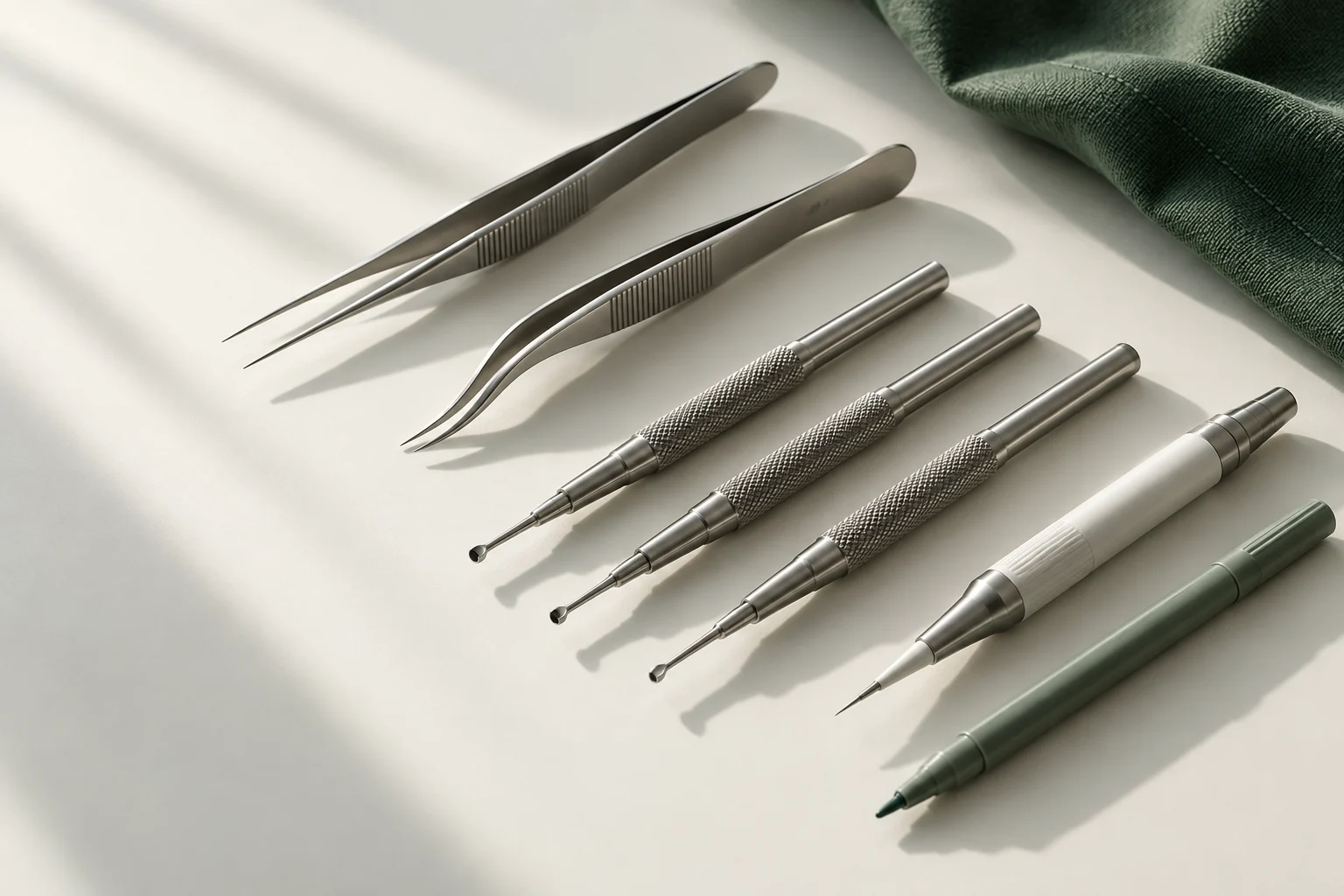
Illustrative still life of fine stainless-steel instruments on porcelain beside a forest-green drape
The tools

The punch is tiny.
Its size matters.

The main tool in FUE is the punch: a tiny hollow needle, less than a millimetre wide, that lifts out one graft at a time. Its size and how it is handled decide whether each graft comes out whole, and how small a mark it leaves.

AI-generated editorial still life. Not a photograph of the clinic’s equipment.

0.80mm wide, about a pencil lead
Choosing the punch size

A twentieth of a millimetre
makes a difference.

Pick a size to compare. Each step is a twentieth of a millimetre, and each one makes the hole clearly bigger. Too small, and the punch can cut through the hairs it is meant to lift. Too large, and it leaves a bigger mark behind. The right size is chosen for your hair at the examination.

Punch width to compare

Hole size: 0.50 mm², 14% bigger than 0.75 mm

Drawn much larger than life. This compares hole sizes only; it does not predict scarring or say which size is right for you.

Actual size

One graft, magnified.

This is a single graft: a tiny plug of skin 0.85 millimetres across, holding two hairs. Keep scrolling and the view zooms out until it is shown at its real size.

Is this life-size on your screen?

Probably not exactly. Screens differ, so this page has to guess how big a millimetre is, and on a phone the guess can be off by a third. Hold any bank card against the rectangle and drag until they match. Every bank card is the same size.

Drawn to scale. A graft is a tiny piece of skin holding one to four hairs, not a single hair. Graft size, hairs per graft and how dense the result can be differ from person to person. Four thousand grafts is an example, not a plan for you.

Beard & eyebrows

Beard and eyebrows
follow their own rules.

Facial hair raises its own questions about shape, direction and which donor hair suits it. The consultation tells you what is realistic for the area you want to fill.

After the procedure

Hair grows back slowly.
Aftercare continues.

Ask for written instructions, a review schedule and a clear contact for concerns.

From assessment to follow-up

Early soreness, swelling and scabbing can occur. Transplanted hairs often shed before new growth appears; full results can take 10–18 months.

Surgery carries risks including bleeding, infection, scarring and poor graft growth. Your doctor should explain the risks and recovery in your case.

Seek prompt advice from Dr. Atul for severe pain or unexpected symptoms.

  1. Day 1Grafts in placeShort stubble and small scabs.
  2. Weeks 2 to 8SheddingMost new hairs fall out. This is normal.
  3. Months 3 to 4First new hairsFine, thin hairs start to appear.
  4. Month 6Filling inMore hairs, still growing.
  5. Month 9ThickerHairs get longer and stronger.
  6. Month 12Most of itMost of the result is visible.
  7. Month 18Final resultThe last of it settles.
A typical pattern, drawn simply. Timing varies from person to person.
A personal assessment

Start with
an assessment.

An assessment looks at your donor area, your hairline and what you hope for before any technique is chosen.

Questions about your hair?
Talk to Dr. Atul.
The first conversation

Let’s start
with you.

Prepare a short enquiry for Dr. Atul. You’ll review it before opening WhatsApp to send it.

Your consultation preference

Please keep medical details and photographs for your conversation with Dr. Atul.

Nothing is sent or stored on this website.

Your privacy

What happens
to your message.

This website does not store your form entries, upload photographs, or use analytics or advertising cookies. Your enquiry stays in the current page until you open WhatsApp.

Choosing “Open WhatsApp” passes your prepared message to WhatsApp. You can review it there and decide whether to send it. WhatsApp’s own privacy terms apply, and Dr. Atul handles messages received there.

For questions about information held by Dr. Atul, contact dratulbhanu@gmail.com.